Saturday, 9 July 2016

A Summer's Breeze; London Tea Club Teas


It's been one of those months! Isn't it always? I've yet to even try any of July's teas from London Tea Club and already I've received June's box! Whoops.

Still, I'm having a relatively lazy day, just watching anime on Netflix, doing a spot of knitting (well, shopping for knitting patterns actually; I'm so indecisive about what I want to do!) and I figured what better way to compliment such a day that having a good, long tea session.

In June I received two black teas and a green tea; Russian Caravan (an old favourite), Apricot Peach (which smells divine and is suggested to drink iced to cool down on a, aha, 'hot summer's day', whatever one of those is) and Kukicha. The Kukicha looks interesting; it looks more like grass than tea and smells rather sweet. There's an underlying note of something familiar in it, too, but I cannot quite put my finger on it; some sort of fruit, perhaps, or flowers? I'm not sure; hopefully tasting it will help solve the mystery. I'm also intrigued to see just how different it is from Chinese green teas, which is what I drink most often (it is a Japanese green tea). June's box also came with delightful free gift; a little card designed by Scout Editions, featuring a brightly coloured 'Kokeshi doll', to celebrate 'the return of [London Tea Club's] favourite Japanese green tea'. I love it when London Tea Club throw in little extras, always makes me smile.

July's box was quite different, with a herbal, a black and a white tea. The herbal is Coffee Rooibos. Yes, you read that right; it's some sort of Frankenstein's Monstrocitea; it looks like rooibos but smells like coffee. I'm sure it's perfectly pleasant (I am a coffee drinker as well as a tea drinker in all honesty), but it's perplexing and certainly made me do a double take. I think this is one of the more interesting teas I have received from London Tea Club. The black tea is a blend of Sri Lankan and Indian teas and dried mint; it smells superb. I love mint tea and this one is one of the strongest smelling ones I have come across. I just may have to buy those Moroccan tea glasses that they sell in Imperial Teas, which I've been eyeing up for nearly a year; you know, just to make sure I'm drinking it properly (yeah, that's it). The third tea I swear when I first read it was called 'zombie'. It's not, it's called Zomba Pearls and instead of loose leaves, it is (quite large) twisted pellets. That's definitely one for a glass teapot.

So today started off with the Russian Caravan; I'm no newcomer to this tea and I currently have a jar of it sat in my drawer. Even in the test tube you can tell this is a particularly smokey tea, even for a Russian Caravan. This particular tea is a blend of Ceylon and Lapsang Souchong. Traditionally, Russian Caravan is supposed to get its smokey aroma from the campfires along the Silk Road (along which the camel trains would travel to deliver tea from China to Russia), hence the name, although the card for this one informs me that 'no campfires were used in the making of this tea'. I brewed it in my little black and green teapot and, rather than using the matching cups, opted to use my new frosted glass tea cup/bowl that I acquired on my last trip to Imperial Teas.

Once brewed, the malty aroma is even stronger and the liquor is a beautiful amber hue. It tasted stronger and slightly more bitter than most Russian Caravan teas I've had before, despite having brewed it for no more than three minutes. This was no bad thing, mind you. The Lapsang Souchong is definitely the dominant flavour in this tea. Although smokey, it wasn't quite campfire smokey (and, having just returned from a week away camping, the smell of woodsmoke is still lingering in my clothes and hair, so I know what it should be like), but more like a cask aged whiskey. Overall it's a very pleasant tea, although perhaps not my favourite Russian Caravan that I have had.

The second tea I opted for was the Kukicha; apparently I was having a sophisticated tea day and not opting for any of the frivolous, flavoured black teas that I do so enjoy (in part, it was because I wanted to try the Apricot Peach iced). The dried tea itself was bright, a mix of colours ranging from lemon to forest green. I placed the tea into my pot (one and a half spoons, this one) and let it brew for two minutes with 100C water, as instructed (oddly, for a green tea). Upon pouring I was surprised by just how pale and delicate looking this tea is. You could be forgiven for not thinking it is tea at all. The aroma is subtle, but earthy; more so than the dried leaves. Upon tasting it I noted that it was subtly sweet, although not in the honey or citrus way that I often find in teas. It's more sweet like you might expect grass to be sweet; 'green' sweet, I suppose. Again, there's a hint of some fruit or vegetable that I cannot quite place. Despite not being a flavoured or blended tea, I would say that this is one of the more complex flavours. It's not as bitter or astringent as most green teas, either; in fact, I wouldn't say it hugely tastes like green tea at all, instead having a flavour closer to something herbal. This is definitely a tea I would recommend to those who want to like green tea but do not (and those who do like it, to be fair).

Kukicha is still Camellia Sinensis, however. Unlike most teas, though, Kukicha is made from the stems and twigs rather than the leaves; basically, all the bits of the plant that are normally discarded. As Kukicha is what the tea is made from rather than how, it can be either green or black. It would be interesting to try a black Kukicha. It's also naturally low in caffeine, so is probably the best tea to drink if you're not wanting the addition of caffeine as there's no industrial processing.

I like Kukicha. This is definitely one to add to my 'buy more of' list. It's quite refreshing.

For my third tea I decided to have a look through my notes; although I've tried most of my teas from London Tea Club, I know that I have not written about all of them (recently I have made and printed a load of pages for my Filofax, so I can keep track of all my teas and my notes on them, which makes blogging after the date so much easier). I noticed there was one from April that I had not written about, but remembered was a delight to drink; Lychee Jasmine. I'd already started on the green teas, so I felt it only appropriate to continue (I was waiting for my boyfriend to get home before I tried the Coffee Rooibos).

Lychee Jasmine is a blended green tea; a Chunmee base (a Chinese green tea, which means 'precious eyebrow' as '[t]he gentle curve of the the dried tea leaf is reminiscent of a lady's hand-drawn eyebrows'), with dried jasmine flowers and, unsurprisingly enough, dried lychees. The brew is a green gold tone and, oddly, smells a little like Swizzels Matlow Love Hearts. It's delicate but undeniably fruit, with a long, lingering aftertaste of jasmine. It is, to my mind, what spring would taste like if it were a tea.

Oh, and one final thing; yesterday I was killing time before a doctor's appointment in Waterstones. I had no intention of buying anything but you know how it goes. Previously I had bought The Book of Tea by Kakuzo Okakura, from Penguin's new line of classics; well, as I was walking down the stairs, there, on the Penguins Classics shelf, I spotted a booked entitled Green Tea. Furthermore, it was by Sheridan Le Fanu. For those of you who do not know, Sheridan Le Fanu was a 19th Century ghost story writer and happens to be the author of my favourite vampire novella; Carmilla. So unlike The Book of Tea, Green Tea is a work of fiction, but between its title, its author and its low price of £2, I couldn't say no.

 Overall, I'd say July is shaping up quite nicely if today's tea session is anything to go by! 


Sunday, 12 June 2016

Having Fun (Fun, Fun), With the Sun Wukong; 'Ku Ding Serpent's Tongue' Herbal Infusion

Hello to all and hello to summer (alas that this muggy, monsoon weather is British summer). It's been a while; in part because my phone bust (as I mentioned in a previous post) so I have been unable to photograph my teascapades and, let's face it, what is a blog without pictures? The other part s that I have been enjoying the (however sporadic) wonderful weather.

Even though I've not been bringing my tea adventures to the internet, that doesn't mean that I have not been indulging. No, in truth I have decided to start summer by expanding my already far too extensive (she says with no hint of regret) tea collection; I took a trip up to Imperial Teas, braving the dreaded Steep Hill, which, as those of you who have quested it know, is no misnomer. Sometimes I feel that I need mountaineering equiptment to reach the top and this recent trip was made more excruciating by a recent two hour trip to the gym which had left my legs aching. Still, I knew I would be rewarded with tea.

I went with the intention of buying a particular tea that I had seen on their website, as well as a few things for my dad for the upcoming Father's Day. The tea that I had seen was one called Serpent's Tongue, which I found out after purchasing, is actually not 'tea' in the truest sense (that is, it is not Camellia sinensis). While I was there, as always, I may, or may not (I most certainly did) have treated myself to more than I went in for. Oops. I ended up leaving with 750g of tea, which consisted of seven different types/flavours. Exciting times ahead!

After popping in to one of the local cafes for a delectable afternoon tea, we toddled on home with me spending the entire journey home deciding which tea to try first. Eventually, with help from my boyfriend, it was decided to try the Serpent's Tongue first, as it is the one I gone with the intetion of buying. As I said before, it's not technically a tea; it's what is called 'Ku Ding'. Ku Ding is a 'bitter tea infusion' that is usually made from either Ligustrum robustum or Ilex kaushue/kudingcha. This particular Ku Ding is made from the latter; it's related to both the holly bush and the same herb that makes Yerba mate. This particular Ilex kaushue was grown on the Chinese island of Hainan.

Unlike normal tea, the leaves for Ku Ding are rolled into thin pipes and have the appearance of, well, a non-forked serpent's tongue. It's this unconventional shape that gives the infusion it's name. I decided to brew it in my plain glass teapot so that I could what happened as the leaces brewed. For a single cup you need two to three 'tongues' or rolled leaves, so 100g of this particular tea could last a while.

Oh, something I forgot to mention; the other day my latest piece of tea paraphanalia arrived from China. It was a long awaited tea pet! What is a tea pet, you ask? A tea pet is small animal figurine made from the leftover clay used in making Yixing (a type of clay) teapots in China, which are left unglazed. Tea pets are raised by letting them 'drink' tea, by pouring it over them. As they're unglazed, they absorb the tea, eventually taking on the colour and aroma of the tea, giving them a glossier and darker appearance. They're usually used in the Chinese gong fu tea ceremony, which involves several steepings (so the first steeping, which is not meant to be drunk as it is used to 'wake up' the leaves, can be poured over the pet; alternatively, left over tea (whatever that is) can be used) and a bamboo, slatted tea tray, so a mess isn't made when you feed the tea pet. I, unfortunately, do not (yet) have a gong fu tea set, so I had to improvise. I know it's likely more tea ettiquette to pull something out of a particular cultural ceremony and use it my own way, but ever since first found out what a tea pet was, the idea of having a friend to share all of my tea adventures with appealed. I liked the idea of having something that I ould infuse with teas from important events in my life, such as going on holiday or my morning tea on graduation day And, of course, my expensive and fancy teas.

The tea pet I bought was a little bigger than I expected, but even cuter in real life than in the images. I spent ages choosing a tea pet as there are so ma ny different designs; buddhas, pigs, dragons and so on. I knew the animal I wanted, but they seemed a little elusive. Eventually I found exactly what I was looking for; a monkey! Why a monkey? My Chinese Zodiac is the monkey; when I was younger I used to think it was a rather dull animal to have, but when I became a little older I realised how important they are to Chinese mythology. You have my dad introducing me to Monkey Magic to thank for that. Ever since, I've loved the symbolism of the Zodiac Monkey; I've worn the word 'monkey' in Chinese characters around my neck near enough every day since I turned fifteen. In homage to my favourite monkey, my new tea pet has been named Sun Wukong, after, well, Monkey. It means 'Monkey King' (I did consider Qui Tian Dasheng, or 'Great Sage, Equal of Heaven, which is one of Sun Wukong's titled, but it was decided against, as 'Sun' makes a much better shorted name. 'Sun' means monkey, for the record.) This little monkey cost me a little over £5 (including shipping) from the bay of e (although, oddly, I could only find it on the American site).

This was the first tea I had brewed since my little tea pet arrived and I figured Sun was probably a might thirsty after the long travels from China. As such, Sun was involved in the preparation of the Serpent's Tongue. It felt a little wrong, my tea pet's first drink not actually being tea, but it was Chinese, so there was some reasoning.

Serpent's Tongue has a distinctly smokey smell when in the packet, not too disimillar from a Lapsang souchong. It's not the smokiest tea I have ever smelt, but it was definitely present. I placed three pieces of Serpent's Tongue in my teapot and poured over the hot water, which instantly became a mellow green (far more rapid than most teas). Little bubbles started trailing out of the twisted leaves, so much you could almost mistake the liquor for being carbonated. The brewing time suggested 3-5 minutes at a temperature of 100C. I set my timer for three minutes, which is my standard when given a time range that includes it (most black teas need steeping for around 3 minutes for my preference). I sat with it on the coffee table and watched as one of the leaves refused to sit still (would you if you were being boiled alive?), it floated, it sank, it reared up, it unfurled and with no sublety. It was a joy to watch. Once the timer chimed, it was time to pour three cups of tea; one for me, one for my boyfriend and one in which Sun sat, awaiting a little teacuzzi (no bamboo tray, remember? I said I had to improvise).

Sun delighted in getting the first sip of the Ku Ding. The liquor itself was surprisingly pale, although distinctly chartreuse. Much like the dry leaves, the infusion still had a smokey scent. Surprisingly, upon first sip, there was little to no smokey flavour, although the flavours present were bold. This is not a subtle Darjeeling; Ku Ding hits with full force, right at the back of the palate. I even felt that it had a slight aneathatising effect, like eating a particularly insubstantial clove. It's flavour is not unlike a strong green tea, although less astringent that one oversteeped. It is bitter, but there are notes of liquorice. For all it's strength it does not feel over powering and is, despite it's heavy flavours, extremely pleasant. That said, there was a little liquor left in the teapot that we decided to pour after finishing our cups (so it had been steeped for well over fifteen minutes); neither myself nor my boyfriend could finish this for it's potency. This is certainly a tea that needs to be brewed correctly (fortunately, Sun only drank the well brewed Ku Ding).

Serpent's Tongue had an unanticipated flavour, one that, in description, sounded not at all to my liking, but in reality was favoured. I do not feel that this is a drink I will partake in every day, but perhaps after a long day or the occasional early evening with a book. I do not particularly feel that, outside of tastings, this is a tea for sharing; more for a quite time to energise or replenish. In Chinese medicine it is said to 'clear the head and eyes', being used for the 'common cold', to 'alleviate fidgets, thirst and coughing'. As I said, it's one for after a tiring day at work. Due to it's unusual shape and it's suprisingly potent kick, this is one tea I am very glad to have added to my collection and would recommend to any fan of green tea.


Sunday, 8 May 2016

May I Share this Gourd?; the Teas of May and 'Radiance Blend'

New month means new teas! Although one does have to wonder where the year is vanishing too.

May opens up with some delights from London Tea Club; the herbal Radiance Blend and black teas Charles Dickens and the flavoured Opera Rose. I can't tell you how excited I am by the Opera Rose tea; one of my favourite teas is China Rose, which I bought locally from Imperial Teas, or, when my only options are less artisan, Twinings' Rose Garden. I'll confess, I was bought the Rose Garden tea on a whim, fell in love and promptly searched for a better quality rose flavoured tea at Imperial Teas (my go to for tea shopping). My mother also bought me a rose tea from Whittards of Chelsea, so that I could 'have a fancy tea she liked' (my mother is not a fan of much else other than Earl Grey or English Breakfast, unlike my papa) buuuut this got lost before it even got to me.

The suspicions currently lie at my brother's door. Hmm!

The back of the newsletter had a rather stunning photograph of Wuyi Mountains in China, where London Tea Club have recently been, sourcing their teas. Wouldn't it be fantastic to take a trip around the world to source teas? Ah, one can dream!


The same day I'd also been out shopping with my boyfriend (mainly just enjoying what scant beautiful weather England wants to provide us this year) and I saw that Penguin Classics had released a new set of books, including  The Book of Tea by Kakuzo Okakura. Have I heard of it before? Not at all, but it was all of £2 and is the '1906 guide to the beauty of the tea ceremony' which is 'both a paean to the art of simplicity, and a wry critique of the West's view of Japan'. I felt that it was worth adding to my collection and will hopefully in due course teach me more about the wonder that is tea.

To date I have read little more than the first page; today has been a lazy kind of Sunday and from what I have read, it is a book that need concentration. Not today then!

Last night I was home alone and recovering from a long week that culminated in a sickening three day migraine (hence the need for a lazy weekend). I curled up in my pyjamas, put Netflix on and treated myself to one of London Tea Club's teas. I decided to go for Radiance Blend as the card informed me it was 'best enjoyed in a bath with Himalayan crystal salt and lavender'. I don't have a bath (or Himalayan crystal salt or lavender for the matter), but I felt like I was doing my only possible equivalent, of being snug and cosy and calm on the sofa. (I've also just realised; is the salt and lavender meant to be for the bath or the tea? Huh.) The card further described this blend was 'a champion of self-care, deep healing and radiance'. After the week I had had, it sounded very much like what I needed.

I also apologise now for the quality of the photos in this post; unfortunately my phone went caput and is was taken in for repairs last week, leaving me with my older model and its lower spec camera. I told you it had been a long week.

Radiance Blend is a herbal blend of green mate, lemongrass, spearmint, nettle, ginkgo (leaves from a Chinese tree), ginseng, cornflower, calendula and sunflower petals. I have a huge bag of plain green/yerba mate (Ilex paraguariensis) in my tea cupboard of which, I'll be honest, I am not a fan. However, I was intrigued to see how this blend stood up, as I know mint or lemon is often added to yerba mate for flavour.

For those of you who do not know, yerba mate is a South American plant that is used to brew the popular regional beverage, mate. Mate is traditionally drunk from a calabash gourd (literally a hollowed out gourd) using a bombilla ('bom-bee-yah'; a filtered metal straw) and as part of a social gathering; the host prepares the mate in the gourd, drinks from it, refills and passes it to the first guest, who then drinks from it. It is then refilled and passed on until the yerba becomes lavado ('washed out'). Unlike Camellia sinensis, preparation of mate requires a large amount of the dried leaves, usually filling up about two-thirds of the gourd (can you imagine the strength of the infusion if that were tea?!), which allows it to be resteeped several times, making the passing of the gourd to other guests possible.

As I mentioned before, I am no stranger to mate, but it is far from a favourite. I've brewed it several different ways (adding peppermint tea, honey, rum, etc.) in attempts to make it more palatable to me but, ultimately, it ends up tasting too bitter and far too much like eating old, musty vegetables for my liking. But here it was, in a blend recommended to me by London Tea Club, and, so far, everything they have sent has been wonderful, so surely this one couldn't be so awful as I remembered? Certainly, this blend smelt incredible.

So after a short fight to get the cork out of the test tube I went about preparing it. How did I prepare this infusion? Why, in my calabash gourd, of course! You didn't think I would have come this far in my tea journey without having acquired such a piece of paraphernalia? Why did you think I had the yerba mate in the first place?

Now, I was a little confounded when I went to brew this tea; the test tube proudly announced that this tea needed to be brewed at 100C, but I have always been lead to believe that yerba mate should be brewed at around 70C, so as not the scald the leaves and, also, so you don't split the gourd. I decided to brew the infusion as The London Tea Club had instructed, so I poured the leaves into one of the supplied teabags and prepared it in a jug so I could use boiling water without damaging my gourd. After the recommended 7-10 minutes (and checking with a thermometer that the liquid was cool enough) I poured the liquor into my gourd. I made more mate than there was room in the gourd, so I poured the remainder into a pre-warmed thermos as a slight twist on the tradition of carrying around a thermos of hot water to refill the gourd on the go (apparently very common sight in the streets of Uruguay). I was also intrigued to see just what mate would taste like with a 'tea' amount of leaves.

My infusion was brewed, my gourd was full, it was time to settle back down on the sofa and relax. Once in the gourd, the drink just looked black, any colour cast in shadow. Fortunately, I had thought to make a note of it while it was still in the jug; it was a vibrant, spring-bud green. Much brighter and more vibrant than a green tea. My photographs, unfortunately, did not quite capture just how pretty a hue it was (instead making it look far more gold).

My first thought as I sipped the drink through my bombilla was that it was a little weak. This was my fault; I fear I was a little over zealous when adding the water to the jug. Although (ironically) it was not as strong as I would have liked, it was pleasant and thoroughly refreshing. Despite the weakness of the brew, the flavour was surprisingly bold (it would have just been improved by a more balanced water-infusion ratio). I felt the spearmint (a satisfying change from peppermint) was the predominant flavour, but there was a sharpness to it that can only have been the lemongrass. It also tasted quite verdant, as to be expected from a mate, but far less bitter and harsh. There was a lingering, subtle sweetness, although I'm a little unsure if that was the infusion or the gourd; as the gourd is a natural produce, it's inner is porous and absorbent, often picking up the flavours of whatever is put within. As I mentioned before, I have added (a lot of) honey to my mate previously, so it was difficult to tell if this slight syrupy flavour was from the container or the brew.

As I topped up my gourd with the last drops from the thermos, I realised I had not stopped to smell the tea, so relaxed was I. I did hold the gourd to my nose to try to detect the aroma but, much like the sweetness, it was hard to tell what was gourd and what was not. The gourd itself smelt a little like wet wood, as always, and, given how small the opening was, I felt this masked the scent of the brew within. From what I could determine, however, the infusion smelt of citrus and the dewy, spring grass.

Overall, unlike my previous encounters with mate (including a couple of not-so-biting trials at cafes, which both resulted in a burnt tongue from a too hot bombilla), this was a very pleasurable and did not need to be forced down. Afterwards I felt both serene and rejuvenated from the migraines, which was particularly impressive when you consider I was watching a TV series with zombies. As the Radiance Blend card says under 'brewing tips' it is 'an uplifting brew for both busy days and quiet nights', and was just the pick-me-up I needed that calm Saturday evening.

Tuesday, 26 April 2016

A Godly Brew, 'Monk's Blend',

Let us continue with a theme; while I realise I have still yet to review teas from January and February, I fell that, for once, I should concentrate on one thing rather than jumping around. Fear not, we will get to Frozen Summit some day (I have drank it, I have my notes, I just... Haven't written it all up). Honestly, I feel that I am gaining tea quicker than I have chance to write about them (even at once a week London Tea Club alone takes nearly the whole month and, the way things have been going recently with many a tea gifted unto me, that still leaves me with a surplus to review).


Today I'd like to introduce you to the second tea from London Tea Club's March delivery. The light and humble taste of Monk's Blend. It's a Ceylon base, with vanilla oil, grenadine and calendula petals. Such a description sounds more like a cocktail than a tea blend. I'm not sure if it technically constitutes as a Ceylon tea though; a Ceylon tea can have no less than 100% of its leaves grown and produced in Sri Lanka. Now, given that all of the actual tea is from Sri Lanka, does that mean it is a flavoured or blended Ceylon tea? Or does the addition of any other ingredient (even when it is not more tea) make it no longer Ceylon? I'm afraid I don't actually have the answer to that, but still, fun fact about it being all or nothing, right? It's a bit like 'sparkling wines', I guess; you know, how it isn't Champagne unless the grapes are grown in the Champagne region.

I actually did a little bit of research into Ceylon tea before writing this post with the intention of adding the odd entertaining anecdote, but realised that the history of Ceylon tea is not only lengthy but genuinely fascinating. The more I learn about tea the more I realise just how much this humble plant has shaped human culture. As a result, I've decided to not discuss it here, but (tea)leave it until another date, another post and dedicate it to the history of Ceylon. Honestly, it deserves it and stops this post being three times as long as it needs to be.

I decided to brew the Monk's Blend in my then new (and still newest!) teapot, my black and white yokode kyusu. 'Kyusu' is simply Japanese for 'teapot', but what really sets this teapot out from my (many) other Japanese tea ware is the 'yokode' bit, or, in English, 'side hand(le)'. Rather than having a handle that goes over the top (like most of my Japanese teapots) or a handle at the back (like most of my Western style teapots; you know, the 'classic teapot' shape), it quite literally has a handle at the side. It look a little like an earthenware saucepan with a spout. When I first bought it I thought that the 'yokode' would make pouring a little awkward and unnatural, but thought 'what the hell' and bought it anyway because it has a side handle. Honestly? I am so glad I gave in to that (somewhat expensive) whim. I get such a sense of pleasure pouring from this teapot; the movement feels far more fluid and controlled than from a teapot with an overhead or back handle. I was astounded; I never thought that pouring tea felt wrong but somehow using a yokode kyusu just feels right. It is very peculiar, but I took it over to my parents' place after I bought it and my father agreed that it was the most satisfying and instinctive ways of pouring tea.

It's bizarre. When I started this tea journey I never realised just how vastly different tea paraphernalia could be. If you ever get the chance to try out a yokode kyusu jump at it, although make sure you find one that matches your handedness (that's right! Left and right handed teapots!). That said, my left handed mother had no issues using my right handed yokode kyusu. I am in love with how pouring from the teapot feels.

As this teapot did not have any matching cups I decided to buy myself a new bowl; it's larger than most of my Japanese tea bowls and features a delightful design of swimming koi on the inside, while to outside is a plain white. It means that the koi end up swimming in the tea and allows the pattern to be seen while you drink. I thought it was a very elegant and I approved of the size. I had yet to use this bowl when I brewed Monk's Blend and, as I was using the yokode kyusu I had purchased alongside, it seemed fitting to drink my new tea from this bowl (even if it meant I was mixing tea cultures with Ceylon tea and Japanese paraphernalia).

I am getting distracted, such is my excitement for teapots and histeaory.

Monk's Blend is quite a pretty tea to look at; dark leaves flecked with lemon colour. Once brewed it is is a vibrant amber. The flavour is light, delicate and floral. As it rolls across the tongue, hints of citrus notes become apparent. There is an unmistakable fruitiness to the liquor, no doubt the result of the added grenadine. The flavours of Monk's Blend are subtle and complex; at first there is the floral, fruity bouquet, followed by a smooth and lingering after taste that is distinctly Ceylon. Overall, a very pleasant and satisfying tea.

London Tea Club say that 'we're not sure which monk invented this blend but we agree that it's heavenly' and I am wont to agree.

Tuesday, 19 April 2016

London Tea Club: March and 'Castleton Darjeeling'

It's been a while, eh? This is the bit where I waffle excuses, but I don't really have anything specific other than just 'I've been generally busy'. That said, I actually have a couple of posts written up and saved as drafts; not sure why it has taken me so long, but expect these to posted in the coming days (or not...)

Let us travel back to March then. Peering into my postbox at the start of the month, there was the final box of teas from my gift subscription (fanx mum). So what wonders did March have to offer? Two test tubes, neatly labelled Castleton Darjeeling and Monks Blend. The third? A little sachet, displaying the words White Peony. Why a sachet? Well, the tea leaves are dried whole and, unlike an Oolong where the leaves are curled and twisted into tiny beds, the leaves are flat. Essentially, the White Peony leaves are too big to be kept in a narrow test tube.

Underneath the tea (and the little London Tea Club bag that comes with each box), there was black business card alongside the usually monthly newsletter. This card reminded me that this was, indeed, the final box in my gift subscription (it had also mentioned this on the address label on the box) and that they hoped I had enjoyed my membership. It also offered me a special code that allowed me to get the next month's box free should I wish to continue! Hooray! More tea for me! Naturally, I signed up for April and do intend to continue to get the tea box, funds allowing (I have far too many monthly subscriptions currently).

But of course, you are not here to read about my subscriptions, you are here (presumably; if you're not, I'm not quite sure what you're expecting) to read about tea.

Let this post introduce you to Castleton Darjeeling. A truely divine tea if I ever found one. Properly brewed, this tea is one of the finest black teas I've ever tasted (and I have tasted a fair few). Did you know, that Darjeeling teas are referred to as 'the champagne of teas'? No, I didn't either until London Tea Club told me; certainly, this tea shows it.

Before I move on to the tea itself, let me tell you a little about Darjeeling teas. Interestingly enough, Darjeeling teas, although grown in (unsurprisingly) the Darjeeling district of West India, are grown from the Asian strain of Camellia sinensis (the sinensis varient) rather than the Indian strain (the assamica variant). Apparently there are only seven valleys, comprising of eighty gardens, that grow Darjeeling tea and an individual bush only yields about 100g of dried tea per year. This particular tea comes from the Castleton estate from the Kurseong district; hence the name, really. The estate was established in 1885 (and the Camellia sinensis plant can produce useable leaves for over 100 years with proper care, so this is historic tea I'm drinking right here) by an Englishman, Dr. Charles Graham. So this tea is an Chinese plant, grown in India by the English; with the three main players in tea, it is surely the truest form of internationalitea, no?


Despite being such a fine tea, I decided, rather boorishly in hindsight, to brew it in one of my favourite mugs. The sentiments emblazoned across it are true enough 'Where There is Tea there is Hope'. I also used my silicone flower tea infuser, which always brightens my day, as it pokes out of the top of my mug. It also has a matching flower pot to catch the drippings when I'm done; delightful!

So, what about this particular Darjeeling? While this is not the first time I have drank Darjeeling, it is perhaps the first time I have appreciated it for what it is (you know how it goes; you're at a cafe, they tell you they serve 'specialty teas', so you opt for the brand name Darjeelings, it's over steeped and bagged and, quite frankly, just tastes like tea) and, until now, I've not actually had any in my collection. This is also a 'second flush', that is, the leaves have been picked during summer, rather than spring or autumn.

The aroma of this tea was almost citrusy; a faint reminder of sour-sweet fruit, even though this tea hasn't had sight of a lemon or orange. You could be fogriven for thinking otherwise by looking at it; its colour is a pale lemon. It also has a distinctly honey like quality; thick but smooth and slightly sweet. It rolls across the tongue and lingers at the back of the mouth, leaving a long lasting impression. If gold was a drink, it would be Darjeeling.

I feel that I need to add more Darjeeling teas to me ever growing, over flowing collection. That way I can better appreciate the subtle nuances that separate Castleton Darjeeling from others. Still, as an introduction to this finest of teas, I am very much impressed and certainly look forward to imbibing another cup. Much like champagne, I feel its a tea for celebrating with, for sharing or for after a long, tiring day when 'fuck it, I'm having a drink'. Just, in this case, its not alcoholic. And I'm not sure I'd recommend adding a shot of vodka to this (or any?) tea; it's perfection as it is.


Sunday, 27 March 2016

Curioser and Curiositea; 'Turkish Apple, Yoghurt & Lime'

Firstly, merry Easter to one and all. Hope your Bank Holiday weekend has been relaxing and fruitful and everything you wanted from it. I also hope you hangovers tomorrow from excess wine and champers on this day of resurrection are not overly painful and that, unlike Jesus, you won't need three days to rise again.

I am well underway with my celebrations. The roast has been cooked and eaten, the vegan brownies devoured, the Oxford Cambridge boat race on the televisual screen and a pot of fancy tea brewed and being sipped upon.

How better to do Easter than with tea? And I figured I ought to share this little bit of Sunday joy with you all.

Today we have opted (amongst many) to indulge in 'Turkish Apple, Yoghurt & Lime'. It was one half of a gift from a friend for allowing her to stay at mine a few weekends ago. It was bought somewhere in York, I believe, from a company called Hebden Tea. In truth, I only know this because their logo is blazoned across the label. I have tried this tea before now, and I am certainly a fan, but this is my first time sharing it with family. I say family; I mean my father. He's like my back up tea drinker, with whom I bounce opinions on tea off of.

This tea is technically not a tea; it is, and I can hear your shudder the other side of the internet, a fruit infusion. I know, I know. I am a heathen. But hear me out. While supermarket bought, mass produced fruit infusions often taste like nought but hot water, or occasionally like it has been sieved through a shirt, artisan fruit infusions can be very pleasant. I have no qualms with finely made fruit infusions.

So, this Turkish tea, what of it? It is made up from solid pieces of dried apple, pineapple and lemongrass; there is also some flavouring, which I presume is the 'yoghurt' portion of this beverage. After letting it brew for a solid six or seven minutes (fruit infusions need this long, otherwise their flavour is weak and pitiful) it was ready for drinking. It has an intense yellow colour and a strong aroma, a heady mix of sweet pineapple and sharp lemongrass.

The flavour is powerful; both sweet and sour, yet well balanced. It reminds me of Swizzel-Matlow's Refreshers; almost fizzy, sugary sweet and biting at the back of your tongue. I find it, much like the namesake of the sweet, rather refreshing. It is not the sort of tea you would drink after a heavy meal, or when you want to relax, but more something on a clear summer afternoon, when you want a pick me up but don't fancy reaching for a chocolate bar. It's the sort of drink I can imagine enjoying while on a laugh-filled picnic with close friends.

When asked, Mr Dad had to say 'it reminds me of lemon meringue or warm Lipton's. I feel that it would be nice iced on a nice, hot summer's day'. I have to agree with the latter sentiment; this would be divine chilled, too cool down. Hopefully I will remember this on the one day of British summer.

Overall, if you dare to venture in to the heretical world of real fruit infusions, this is definitely a good place to start. If you're already a damned tea heathen, then it is still worth sampling if you ever get the chance.


Saturday, 12 March 2016

London Tea Club: February and 'Blossoms & Berries'

It would appear that I am doomed to forever be playing catch up. It's not that I've taken a sudden, adverse liking to tea drinking, no, no. Just, as always, my tea drinking happens much quicker and at a more timely fashion than do my review write ups.

(I've also contracted a ghastly bought of flu, followed by repeated migraine attacks. Not that this is an excuse for such a long time in writing, but it hasn't helped.)

So let's all make like Time Lords and return to colder times; February. My second delivery and quite possibly even cuter than the first. As February is the month of adoration, this little box came not only with the three test tubes of teas, but a little pair of handmade, heart shaped biscuits. Rose petal and lavender, in adorably bite sized pieces by the company Sweet Carolina. Definitely unexpected, but brought a smile to my face on a blearly, blustery evening. Furthermore, as I was inspecting the teas themselves, I realised that on the reverse side of the monthly news letter, there was a recipe for the biscuits themselves. Something I thought was particularly attentive, was that the recipe included vegan alternatives for the milk, eggs and butter. As some of you may be aware I have recently been trying to cut down on my consumption of animal products and, being lactose intolerant and having grown up living with someone allergic to eggs, I've been a long time fan of veganising food, so as to incorprate everyone's dietry requirements so no one has to miss out on tasty treats just because their guts say knob off. Basically, I think it's really great that people are taking into consideration that not everyone can, or wants to, eat 'regular' food.

Sweet Carolina get a thumbs up from me, for being awesome and accomodating; I really love it when people go the extra mile in regards to food. Going that bit further for 'me' (and anyone who can't/won't have animal products). So often I have to go without, as do many people I know with dietry requirements, so it's really nice to be able to be included. Seriously guys, go one step further in accomodating your friends who have a different diet to you; you'll really make their day. Always makes mine.

Anyway. As lovely a surprise as not only biscuits but a vegan biscuit recipe was, I'm actually here to talk about the tea.

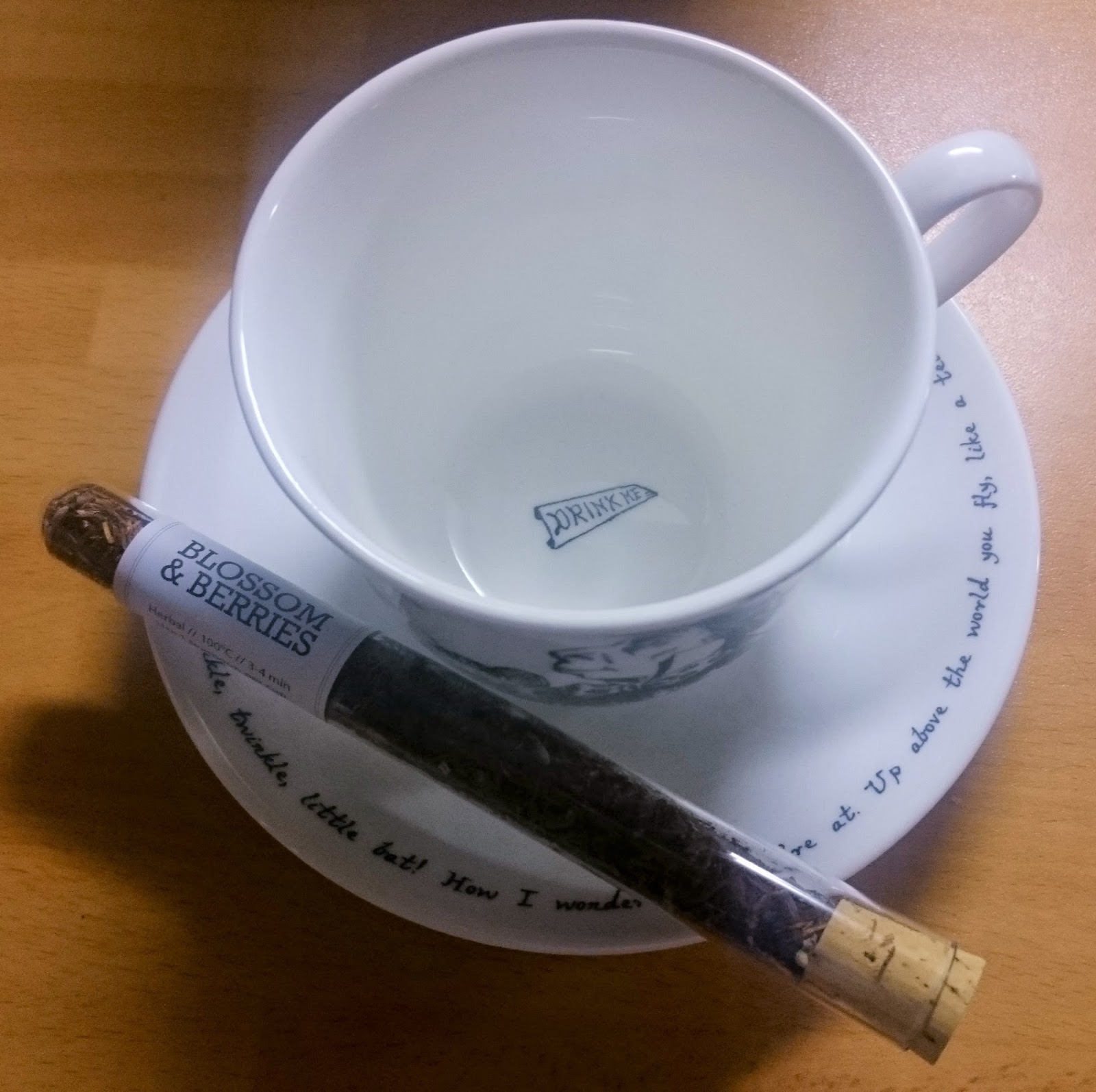
This box came with three teas, flavoured black tea Jasmine Chai, black tea Park Lane, and a rooibos Blossom & Berries. Quite different from January's box, this selection seems more playful and certainly more vibrant in colours. Perhaps it was an attempt to 'warm up', or to mimic the 'love in the air' that frolics freely in February.


Today I'm going to review Blossom & Berries. My first 'herbal' tea from London Tea Club. Rooibos, or 'red bush' (Aspalathus linearis) is a 'tea' (it is not truly tea, as it is not from the Camelia sinenesis plant) from the South African region. It is apparently part of the legume family, so I guess it's a pea tea, really. It's also naturally caffeine free, which is usually toted around as rooibos' selling point over Camelia sinensis; which is great for those who care and, well, wholly irrelevant for those who aren't over fussed what boost their beverage gives them. I suppose it would make it the tea of the pregnant though.


Visually, the tea is a deep russet, with flashes of purple and orange, where the assorted petals and flowers add to the mix. Upon unstoppering the tube, you are met with a piquant scent, sharp and undeniably fruity. It almost smells more like something you would find at Lush than in a tea box.

My first thought is of strawberries, or perhaps raspberries. The 'berry' title is unmistakable, although putting a finger directly on which is a little more complex. Certainly, it smells like a medly of English hedgerow treats. The card mentions the use of blueberries, although to me, the tea smells much sharper than that. Perhaps the red hue of the leaves mistakenly lead the nose to berries of a similar shade.

Still, there is no denying the berries in the name is well deserved. And blossoms; mustn't forget those. It appears, from sight if not scent, that the blossoms are lavender and rose. According to the card, rosehips also play a pivotal role in the flavouring, alongside currents and raisins, which I guess count as berries? Are grapes berries? I guess they must be; not something I had ever really stopped to consider before, just that grapes were generically fruit.


I opted to try this tea in my one of my favourite tea infusers, a whimsical floating duck, rather than a teapot, and drink it from my Alice teacup. I love this infuser; just look at the little quacky grin as it swims about in its tea-y pond. Furthermore, when it's finished brewing, you place the little ducky in a plastic pond, to catch the drips.

The taste, much like the scent, is much stronger than you'd first expect, although no unpleasantly so. Those who prefer flavoursome teas lacking in delicacy and subtlety, would be a fan of Blossom & Berries. As before, it certainly invokes images of the British countryside. Once again, I feel like there is a strong flavour of strawberry and raspberry, despite knowing that neither of these are listed. The 'blossoms' are less distinct, but help create a heady aroma that fills the senses. It tastes of summer, it tastes of the jam in your cream tea. It's delightful, although I've yet to sample a tea from London Tea Club that hasn't been.

Overall, I very much enjoyed this tea, and it was very distinct from those in January's box. I am truly delighted with the variety I've been recieving each month and have to say that February hasn't been a let down either. I would recommend this tea to anyone who likes strongly flavoured teas and herbal flavours that don't taste like soaked socks. This is for those who enjoy something brightly flavoured, in the middle of the day when there's half an hour to spare on kicking back and relaxing.